Showing posts with label BOONDOCKING. Show all posts

Sunday, June 25, 2017

DIY AWNING SCREEN FOR THE AIRSTREAM INTERSTATE

Did you ever wish your van's awning could be turned into a bug-free outdoor room (relatively bug free, at least)?  So did I, but given the size of the project, it took me a couple of years of van ownership before I got around to making it happen.  And because of the time commitment needed for a project like this, let me first show you some commercially-available alternatives, and explain why I we could not use them with our 2007 Airstream Interstate.
Far too bulky for carriage in any Class B RV.  And too Grandma-ish also. 
Ditto on the bulky (look at the top cover).  Plus I didn't know if we'd be able to find the right size to fit our older awning. 
Some of those commercial options are also very expensive, up to about $750.  Here's another example. 
Here, we were getting to the minimalist design that we needed.  But this would still have required modifications, and if it were mosquito netting rather than no-see-um (it looks like mosquito), it would still have been far too bulky to be carried in any Class B RV.
Some of the less-common alternatives were amusing.
If we wanted to sleep six people, that might not be a bad choice. 
The outdoor room is bigger than the van. 
And this gem:
It gets an "A" for originality - the whole van fits inside.  There are a couple of different versions of this on the market.  I would not recommend firing up that camp stove in there, however. 
Last but not least, here's an amusing targeted ad.  It showed up about two weeks after I'd done my screen searches but obviously did not purchase any of them.
No, dang it!  I didn't buy any the first time and I'm certainly not going to be lured in by lower prices on stuff that still doesn't work for me. 
We needed a very minimalist noseeum surround that would pack down into a very small package because of the limited space in our vehicle.  We couldn't afford to devote much space for it, but at the same time, we desperately needed a solution for our planned late-summer 2017 trip to Canada.  The last time we went to our target destination, the mosquitoes were so numerous at night that they would actually wake me up with their collective whining.
Except it's not son - it's daughter.  It's the females that feed. 
Hundreds (thousands?) of mosquitoes would collect on the outside of the Interstate's flap window screen, to the point where the noise became too disruptive to sleep through.  You haven't experienced mosquitoes until you've experienced Canadian mosquitoes.
It's true.  I've known people who plan their outdoor lives around that tiny interval of time between disappearance of snow and debut of the first spring hatch-out of black flies (which typically precede mosquitoes). 
Here are some general pointers on how I designed and executed a custom screen solution.  First, the materials I used.
Black noseeum fabric from Online Fabric Store.  I found the quality to be surprisingly good for such a low price (by that I mean it was very strong and did not melt under a medium heat iron).  I significantly over-bought, ordering 21 yards.  A typical Class B van awning will require something closer to 15 yards (#vansizedsewing).  
This rip stop at JoAnn also proved to be surprisingly good quality - tough, and with no bias stretch to speak of (which is really important for a project like this - don't go cheap or your workpieces will become unmanageable).  I think I bought 3 yards (can't recall exactly). $3.99/yd would be a very good price if you could get it for that.  I paid closer to list.  
It looks like this in the store. 
Here is the "gist" of the two same-sized panels that I made with the intention of having them meet magnetically in the middle.  


Now, you may ask, why did I settle on that design instead of some other?

Well, first and foremost, it became apparent to me that I would never be able to physically manage this screen (put it up, take it down) unless it were divided into sections.  I couldn't sew a single surround where, for instance, maybe you could squeeze into it through the side, where the screen meets the van body.  It would simply be too large.

Logically, then, if it had to be two pieces, the simplifying assumption was to make it into two identical pieces.  Less head work that way, and it would also produce visual symmetry.

So, if I were going to make two identical panels that would meet in the middle, I thought I needed something to signify that entry would be through the middle where I was adding a magnetic closure.  For that reason, and also to increase lateral strength, I added a seam near the bottom of the two side panels, but kept the center panels full-length and less visually obstructed.  It's sort of analogous to what is often done with lobby windows in skyscrapers.  There's usually a visual design feature that orients you toward where the actual door is situated in all that glass.

My construction sequence was as follows, generally speaking for each of the identical panels:

(1) I cut two 70" side panels of noseeum fabric and stitched them together down the side (see second pic down for instruction on the flat seam).
It would be best to have a room-sized table for this work, as they have in industrial businesses that manufacture boat sails and other large fabric items.  But most of us don't have access to that kind of thing, so I used my kitchen floor.  At times I also used painter's tape to hold the fabric in place, as much of my measuring was done off the ceramic tile seams rather than with a tape measure, because the thing was so large. 
(2) I trimmed the tops with the rip stop nylon.  On the panel that must eventually attach to the center full-height panel, I left a "tail" of rip stop to be spliced into the top portion of that center panel.
I cut 4" strips such that, when they were seam-folded on both sides, the resulting top border was about 1.25" wide. 
Six of these strips have to be cut for the top portion on each of the two screen halves, and then more for the central magnetic closure.  I used a 4" template to cut several, and then had to re-square my rip stop before proceeding with more. With large projects, inaccuracies tend to snowball unless they are corrected.  
(One day I will get around to replacing this disgusting ironing board cover.)  This photo shows that the nominal widths of the two fabrics are different, but that doesn't matter.  In fact it's helpful in splicing the various panels together.  You wouldn't want selvage seam to fall on selvage seam.

This photo also shows the side seaming method.  Place two panels together, fold over jointly, sew near the raw edges, open it out, fold it flat over the raw edges, and stitch the seam open.  
(3) I stitched the bottom pieces of noseeum onto the side panels using the same approach.
In yoga terms, there was a lot of wide-legged folding associated with this work - without an industrial-sized work table, this becomes a surprisingly strenuous project.  Here's one of the bottom strips getting positioned and readied for cutting.  
(4) I cut the longer center panels (both of them) and stitched one side seam on each.  This was where the magnetic closure would go, as it is to be encased in yet another strip of rip stop on each one.

(5) I cut and spliced the center strips of rip stop, ironed them (your iron will be your best friend in a project like this), pinned them to the fabric, and inserted the first row of neodymium magnets into that strip to be sewn shut.

Here's my method of working with neodymium magnets in a sewing context.  I hold the magnets to be included inside the workpiece using magnets temporarily situated on the outside of the workpiece.  Neodymiums are so difficult to work with that I haven't found a better method.
So here, for instance, is a close-up of the two center panels.  The neodymium magnets that you see are not the ones that will be permanently affixed to the workpiece - they are holding other magnets in place, that are inside these seams, until I can get them hand-basted into position opposite each other. 
The stitching process will scoot the internal magnets around because the magnets will want to stick to the sewing machine, but if there are "keeper" magnets placed on the outside to control them, they won't get lost in the seam pocket and the outer magnets can be used to re-position them to where they ultimately need to go.  Then, after the internal magnets are hand-basted into place, the outer magnets can be removed. 
It's important to do this magnet positioning thing accurately because otherwise the center strip will have gaps.  And gaps will let in mosquitoes.  Let me explain further.
Here are the two center panels with all of the keeper magnets in place down the center of each converging side.  You can see that they are directly opposite each other - to within a couple of millimeters.  Tap the photo to expand for greater clarity.

Obviously I'm controlling an avalanche of noseeum fabric using clothespins here.  Otherwise, it would be impossible to work with. 
And here's what it looks like once the internal magnets are all stitched into place and attracted to each other, one side panel to the other, and the outer keeper magnets removed.  The resulting magnetic joinery lies flat.  Very important.  
Here's an interim stage of stitching, where both center panels are finished where they meet, and the double side panel is situated beside it.  In this pic, I've yet to add the extra foot or so of noseeum fabric at the bottom of the side panel. 
(6) Once the center and side panels were completed respectively, I stitched them together down their common side.  At that point, I was manipulating a workpiece that was about 82" long and 165" wide, so I needed to employ a lot of clothespins and patience to get it done in a controlled manner.

(7) I repeated the general sequence above for the other half of the project - the other compound panel that consists of three widths of noseeum fabric, rip stop borders, etc.

(8)  You must periodically stop and reality-check your half-finished workpieces against your vehicle.
Here I've got two side panels attached to their center panel and held in place using office binder clips and a few magnets, just for measuring purposes. Obviously a bottom trim piece will need to be added and I will describe that further down. 
In that photo above, you can also see a hint of another reason why I chose to DIY this job instead of trying to buy a product off the shelf.  Notice that the noseeum fabric is bunched up next to the body of the van.  That's because the awning is not fully extended.  And why isn't it?  Look at the bottom of the noseeum fabric.  It's blowing in the wind (in fact, I tried to temporarily weigh it down for this fitting by clamping adjustable wrenches on its bottom edge).  We have noticed that the awning becomes unstable even in light winds, if it is fully extended.  But we can achieve a much more secure configuration by electing to keep it only partially extended.  Therefore, I needed a screen that would fit both scenarios - no winds at all, and light winds - and there's no commercial product on the market that would do that.
Here's a visual way of saying the same thing. 
In other words, I had to customize this screen for a range of awning extension configurations, not just a single configuration.  You'll see how I did that below, and it invokes a very important tailoring principle.  If you look at old pictures of tailors servicing their clients, you never see them sewing a workpiece in a vacuum.  You always see them fitting the clothing directly onto their customers.
Like this.  Random pic from the internet.
The same is true of camper vans.  You can make all the measurements in the world that you want, but this process works best if the customer (the van) is fit in real time, step by step.  So what I ended up doing over and over again was putting the partially-finished screen on the awning, so that I could complete it iteratively.
Of course, this piece of tailoring did not simply hang passively and stay still the way a pair of pants might do on a gentleman.  There's always at least a breath of wind outside, if not an outright breeze, and I had to weigh down the unfinished bottom edge using a variety of available garage tools, including C-clamps, welding magnets, and this adjustable wrench. 
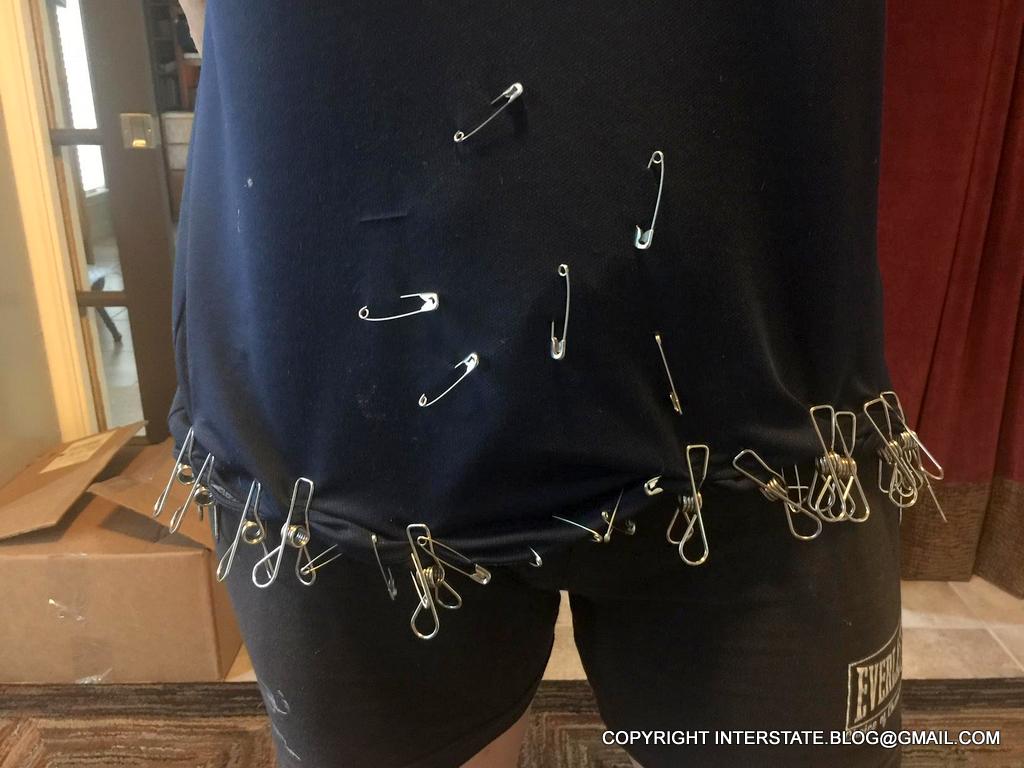
Every time I located a spot where a tie had to be placed, I added a safety pin as a temporary marker.  On a large item such as this screen, a safety pin is more effective than a straight pin.
This is what I looked like during this stage of the project - wearing one of my husband's crappy old baggy T-shirts because our heat index was near 100 degrees F, with all these pins and stainless steel clothespins stuck to me.  Those stainless steel clothespins will be used to augment the paracord ties, and on the internet they are called, "30 Pack Wire Clip, Durable Stainless Steel Clothesline Clothes Pins".  I'll talk more about them in an addendum to this post.  
Once I got everything pinned, I would stitch pieces of paracord in the locations they were meant to be.  I burned the ends with a Bic lighter, but if you do this, be mindful that sharp pieces can remain on the burned ends.  These could snag the no-see-um fabric if not smoothed off. 
In that photo above, you'll notice two ties added to the seam, one above the other.  That's because the upper tie is the one that would be used if the awning were extended to full length.  That tie would then fall at the intersection of this cross-bar.  In that photo, the awning is in its somewhat-retracted position.

Now, a word on that orange paracord I'm using for the ties.
There's no law that says that the ties have to be made of orange paracord - some people would prefer a more subtle approach.  But number one, I have vision limitations that make it difficult for me to see black on black, so using a dark color would hinder my ability to quickly locate and tie off the screen in every place where that were needed.  And number two, using the orange made the screen look very automotive (channeling the phrase "looking very Presidential") - it causes the T1N Sprinter reflectors and turn signal light covers to visually pop.  Personally I like it, but it's a matter of taste.  Plus, orange at the lower level of the tent stakes says, "Don't kick me."

I laughed when I saw that picture above because the reflection of my bare feet is visible in the paint next to the rear turn signal.  God bless Houston - it's almost always hotter than hell.  We rarely do any project with shoes on.  I even cut and de-burr metal while barefoot.  
"Fitting to the customer" allowed me to verify that the center strip of neodymium magnets did, in fact, function as I designed.
I think this is more convenient than a zipper.  Don't worry - those neodymiums will "find" each other if the two halves of the screen are brought in proximity to one another.  That is exactly what neodymiums do best - they "find" what they want to stick to.
This next part is difficult for me to put into words because it's a non-verbal brain thing.  Because I was fitting this for multiple awning extension lengths, there is excess fabric adjacent to the body of the van.  That has to be managed somehow.  I did that by setting it up so that the excess could be folded back over and would meet the first vertical seam in the no-see-um fabric, such that I could tie it off neatly there.
And the next obvious question is, "Well, how did you arrive at that measurement?"  I don't have an answer.  It's a nonverbal spatial thing and I "just did it" without consciously thinking about it.  It's was just a natural derivative of this whole iterative process.  
By the way, here is now I anchored this pair of screens to the body of the van.
LOVE these "Master Magnetics 07580 Magnetic Hook with Rotating and Swing Hook, 1.47" Diameter, 0.54" Thick, 65 Pounds, Black"  They have a rubberized back side so they won't scratch the body metal.  And they are extremely strong. 
Other side of the awning, tied off to the magnet.
(9) Moving on, once I began to refine the fitting in the near-to-end phases of this project, it became possible to verify the bottom trim configuration.  Here you can see one of the two mostly-completed workpieces with the deeper (next to the van body - remember, the awning is sloped) section of bottom trim placed for measuring purposes.  Remember too that, because the awning will be extended variably, this is not an exact science. There is not one single slope configuration to be fit, in other words.
You can see my increasing problem.  Even folded over, the panel has now outgrown my kitchen.  At this stage, it's about 13 feet long and is about to become around 7 feet deep with the addition of the bottom trim.
Don't be surprised if errors get introduced during this massive process.  Such was the case with my effort, where the two panels ended up not being exactly the same lengths, which was important because of the magnetic center closure.  They had to be consistent.  So this predicament caused me to empty half my great room of furniture so that I could lay them out together, one on top of the other for comparison purposes, and make final adjustments to the bottom edge.

And finally, the long-awaited money shot:
There she is - Miss America.  With two REI camp chairs for scale.  
Just as importantly, here's what that money shot packs down into:
Hard to believe that's right around 175 square feet of fabric stuffed into that laundry zipper bag.  It's the size of a small pillow and weighs 2.0 pounds (I'll discuss the stakes and clips in more detail in a subsequent post).  A similarly-sized device crafted out of conventional mosquito screening would be many, many times this size. 
A few words of wisdom for anyone who might be dumb enough, er, ambitious enough, to take on this type of massive project.

  1. Take your time.  It's more work than it looks.  I did mine in stages, across blocks of time in three or four weekends.
  2. Have patience.  Each individual seam is up to 13 feet long, and these are tent seams, so they're really twice as long as that - 26 feet each.  Take a break and watch TV if you get burned out. 
  3. Be methodical.  Inch by inch, life's a cinch.  Use clothespins to control the workpieces, or some other method, so your efforts won't start spiraling out of control.  
  4. Don't sweat the small stuff, and on a project this large, it's all small stuff.  Nobody is ever going to notice an inch thrown here or there on a workpiece that consists of two pieces each thirteen feet wide!  Forget about imperfections and just sew as you go.  The one exception obviously is the neodymium frontal closure.  Those magnets have to line up fairly well, as I described above.

In my next post, I'll talk about making a couple of accessories for this screen, including a "skirt" to go around the van's ground effects to stop mosquitoes from entering the enclosure by that route - from underneath the van.  In the mean time, happy #vansizedsewing!!
Rather a propos given that the Airstream Interstate is often compared to the space shuttle. 

Saturday, April 1, 2017

ADDING A REFLECTIVE ROOF COATING TO AN AIRSTREAM INTERSTATE

This photograph reflects my boundless despair and says everything that needs to be said about this common van-related predicament:
That's an infrared thermometer pointed at our Airstream Interstate's roof and reading 146 degrees.  Conditions when the photo was taken on March 27, 2017 1:40 PM in greater Houston Texas were as follows:  85 F ambient air temp, sustained 3 mph west wind (I was facing west) with gusts to 10 mph, partly cloudy.  I took the photo at a point where there was more than a momentary break in the clouds.  I wanted to see what full-on sun would produce in the way of temperature.  
The interior ceiling below this point read 110 F at the same time.  This is an obscenity.  I knew it was hot, but until I bought that thermometer, I had no idea it was that hot.   Many Interstate owners complain that their vehicle air conditioners can't keep up with cooling demands in the summer months.  This is a big part of the reason why.

Obviously something had to be done to improve the situation, or at least try.  After a lot of research that produced no clear answers, I settled upon a product offered by Hy-Tech Thermal Solutions of Melbourne, Florida.  Why did I choose them?  First, I was guardedly encouraged by what one James Wong, aka Instagram user Eagle2232, had published, and I'm adding a screengrab of it here because content does tend to disappear from the internet over time:
Tap to expand for read-ability.  But then don't take this Instagrammer's instructions as gospel - also see what I have to say in the sections below about application strategy.  
James's vehicle is almost identical to ours, and that's important - a product that might work well on a Class A with a different roof material construction (rubber, fiberglass, or whatever) is of little use to me as a comparator, because I have a standard metal automotive roof.  Unfortunately there's a limitation associated with user forums and other social media outlets - little to no retrospective reporting and follow-up by most users.  At the point where I screengrabbed that image above, it had been posted for 40 weeks.  Well, we don't know what James's roof treatment looked like after 40 weeks (he contacted me on Instagram and I asked him, but I'm still waiting for a reply).  We won't know what it will look like after 150 weeks, or 250 weeks (Hy-Tech's main product Bus Kote is supposed to last 5 years before re-application becomes necessary).  But again, at least this was an example of an application on the same vehicle.  It was the best I could do, research-wise and evidence-wise, at this point in time.

And as an aside, may I observe generally that we Class B DIY owners never, ever pass up any opportunity to increase effective vehicle insulation.  Every small opportunity for gains is seized.  Proceeding from one James to another James, this was demonstrated nicely about a week ago when James of The Fit RV published this post describing how he fabricated a new interior cabinet.  I was only minimally interested in his new cabinet.  I mostly wanted to see the insulation that he added in the process.
Before and after.  It seems that every Class B out there has crappy OEM insulation - why is this?  I don't know - it makes no sense because it's SO IMPORTANT!!

Screengrabbed image pair courtesy of The Fit RV.  
The other reason why I chose Hy-Tech Thermal Solutions is that I phoned them and the person who answered the phone (Trish) took the time to walk me through the products plus the application strategy that she felt would be most appropriate for my particular climate of residence (i.e., near the Gulf Coast, as this company itself is).  So this phone experience further increased my confidence (or perhaps I should say that it increased my hopefulness) that maybe this would prove to be a good-performing set of products for our Sprinter-based Class B.
And by that I mean, this set of products.  I actually needed somewhat less than one gallon of Bus Kote but Hy-Tech had recommended I get two. 
Trish recommended that, following initial surface prep, I use Aqua-Prime #15 as the primer.  Something different is currently stated on their website.  Furthermore, instead of recommending the type of clear coat that James Wong had used on his Sprinter, she recommended that I simply do one coat of primer followed by at least two coats of Bus Kote, and no clear coat, because they (Hy-Tech) aren't entirely satisfied with the way that the clear coat is aging in subtropical environments (honesty in a vendor = points scored).  Then, when the Bus Kote starts to show visible signs of aging, clean the roof really well and add one more layer of Bus Kote on top of it to refresh it, which is an approach that cannot be used if a clear coat is in place.

I will state categorically that I typically will not attempt any project using water-based products, especially on metal.  I'm not a professional, but I've done a lot of painting in my time, and I've just had too many bad experiences with those types of resins.  They often weren't developed because they offered superior performance - they were largely developed in response to environmental initiatives - vendors were forced into creating them by environmental regulations that restricted volatile organic compound (VOC) emissions from coating products.  And then, not wanting to lose money, many of those same vendors tap-danced frantically trying to convince their customers that the performance of the resulting products is still acceptable despite the forced reformulations.

One of my clients whose entire job for the past 40 years has been to track the real-world performance of industrial paints has told me that I'm misguided, and that some water-alcohol +/- synthetic amine type products have actually advanced to the point where they are performing on par with their petroleum-solvent-based analogs, even in the case of metal applications.  To which I replied, "That may be true - but the problem is that we as consumers have no practical way to tell an effective product from a bucket of crap, and therefore I'm sticking with solvent-based compositions."  

However I was unable to identify a solvent-based alternative to Bus Kote.  If you think there is one out there, you would receive my heart-felt gratitude by emailing me to tell me about it (interstate.blog at gmail).

In the meantime, I felt that I had to move forward with some kind of thermal application, experimental or otherwise, and so I chose to go forward with this.  Should a worst-case scenario subsequently develop, I'll spend a lot of future time stripping it back off again and hopefully will find a better alternative.  Sometimes, ya just gotta iterate, as time consuming as it is.

As a final note on my digression, I will also say that I don't necessarily take the performance claims of products like this at face value.  Bus Kote contains a ceramic compound that is claimed to increase its insulation potential (tech data sheet here).  There are specific quantifiable reasons why I question those claims but I won't get into them right now because this post is already lengthy.  I suspect that this product realizes the vast majority of its efficacy by simple virtue of its sky-high reflectance.  But with or without any "high tech" ceramic actually performing a function in the product, I still needed an elastomeric that was designed for an automotive application, so I chose this one irrespective of larger claims.

Now, back to my procedure.  Here's what our roof looked like in its original state.
Sheet metal with several layers of a primer-like paint applied.  To the best of our ability to tell, this is the original Sprinter cargo van roof.  Airstream added the automotive paint everywhere on the vehicle except this central roof patch. 
Of the products you see in the product line-up photo several paragraphs above, I only used the coatings (Bus Kote and primer), the gray roll of 180 grit sandpaper, and the tape.  I deleted the other sandpaper and tack cloth.

I got the tape from our local Tasco Auto Color store.  I walked into the store and asked the proprietor, "Which of these tapes should I use?" and he replied, "Well the blue tape is complete crap, and the yellow tape works very well but will deposit a residue if you leave it on your vehicle for more than 2 or 3 hours."  I had to do three to four coats, so green tape was the best choice for my application, given that it had to remain in place for more than 24 hours.  It's called Scotch 233+.

I strongly recommend that you wash and hand wax your rig before attempting this project, perhaps the day before you are scheduled to begin.  The polymer coating (wax) that Airstream recommends for our vehicle is called Rejex, and I've been pleased with its performance.  Note that the Rejex motto is, Nothing sticks but the shine.  That's very a propos in this context because you will drip something down the side of your rig as you do this project.  Gravity is gravity, and no matter how careful you are, working on the roof of a van conversion is so difficult and so physically exhausting that some little accident is almost guaranteed to occur.  In which case you want fresh wax on your vehicle (everywhere but the roof, obviously) so that you can remove little roof coating drips and smears and splatters cleanly and easily.

This first phase of work takes a strong, able-bodied person about 4 hours.  I started at 3 PM on a partly cloudy day but later regretted that strategy for reasons I'll reveal below.  I recommend that you begin in the early morning instead.

First step in the process is sanding.  I used a 180 grit automotive paper we had left over from another vehicle-related project years ago, so I cannot give you its brand.
Our roof finish looks shiny in the background of the photo above, but it's really kind of satiny.  Notice the amount of paint dust in the foreground - it is necessary to remove that shine before applying any new coating, because I know of no coating that will adhere properly to a mirror-finished surface, be it latex or an oil-based enamel.  I used a sanding block for the flat areas but manually did all the areas around the roof ribs and penetrations.  By "manually" I mean, I took the sandpaper in my hand and sanded the old-fashioned way.  There really isn't a tool for that kind of work. 
Another view of the sanded roof, near the completion of the process, without all the sanding fines (dust) removed yet, hence it appears chalky.  
There was too much paint dust remaining after this process for it to simply be wiped off, so I did a very thorough rinsing with the garden hose.  Then I gave it a good detergent scrub.  I use Dawn dish soap, original formulation with minimal additives, as a general surfactant in many applications (I even wash our dog with it).
Don't just wash it passively but scrub it by hand, to remove anything that might be loose or still waxy after sanding. 
Then I towel-dried it by hand and gave it about 30 more minutes to thoroughly air dry.  Remember, this is the same roof that was reading 146 degrees F earlier in the day, as shown in the introductory photo to this blog post.  By the time I got done with the sanding, and especially after I gave it two big-time water rinses, the roof temperature had fallen significantly, but it was still warm enough to air dry quickly.

After masking the seams, I applied the primer largely using a thin 4-inch roller.  I used a brush to reach into crevices such as under the edge of the roof a/c unit.

Again, I had to grit my teeth and bear it, suspending disbelief as I was applying a latex-based product over prepared metal.  I worked counter-clockwise around the vehicle, pushing the paint tray ahead of me (be careful it doesn't flip off the roof in a stiff gust of wind while doing this - that would be a full-on disaster).  By the time I made it all the way around, the first areas I'd painted were dry to the touch.

It's a good idea to be physically fit if you are attempting this job.  I cannot tell you how many times I climbed up and down the ladder during this whole process, and on top of that, there's the need to contort the body around all those roof appurtenances.  It was tiring.
View looking diagonally toward the rear, primer coat. 
Now comes the reason why I recommend you start this project in the morning.

I had intentionally timed this primer application to give it at least five hours to dry prior to the setting of the evening dew.  That should have been sufficient, but we happened to have a heavy dew that night.  The result is that it softened the newly-laid primer and lifted it off the metal in a few areas.  I knew that this was a possibility but I thought I had allowed sufficient set time so that it wouldn't happen.
So much for my day's plans.  I had been hoping to put the first layer of Bus Kote over the primer early in the day, but the primer was just too soft.  That navy cloth you see there is an old T-shirt that I used to carefully sop up the worst of the dew.  You can see that it took some of the primer off, chalky-like.  This is one reason why I generally don't use latex products.  
In retrospect I should have either started first thing in the morning, or driven it back to its garage to spend the overnight hours in dryness following an evening application.  Live and learn.
Rubbing my hand over the dewey primer produced this effect.  Did I mention that I despise latex products, with or without dew?  
I should qualify that "despise" statement above.  The right elastomeric in the right application is a tremendous asset.  Years ago, I researched elastomerics within the context of house painting.  I was staying at home with my baby at that time, so I had lots of time to vet products thoroughly.  I did a ton of reading, ordered samples from paint manufacturers, applied the samples to my stucco house, and ultimately I special-ordered a particular elastomeric that proved to be amazing.  We subsequently moved, but when I look at that house on Google Street View today, I think my original paint job might be still there, 16 years later!  That kind of durability and longevity is unheard of in our Texas climate.

But the key words are right, and right.  I don't yet know whether this combination of products, the primer and the Bus Kote, constitute the right coating in the right application.  Obviously I'm obsessing over my own trepidation here.

OK, onward.

I did the roof sanding, prep, and primer on March 27, experienced my dew-related dismay sequence early on March 28, did primer touch-ups that morning and allowed that primer to harden in the sun all day on March 28.  Then, I added the first coat of Bus Kote late that day, after I was sure that the primer had set properly.
It's a thick sucker.  As with the primer, I recommend a 4-inch roller.  
Stir well before using.  
I put the van in our storage unit that evening (March 28) to protect it from additional dew.  In fact I did that between each successive coat, allowing each of them to set overnight in dry conditions before proceeding with the next.

On March 29 we had a tremendous storm that produced 3 inches of rain, so the van remained enclosed and nothing got accomplished that day.  Work resumed under the blue-bowl intensely-dry post-frontal conditions of March 30 and 31, when I added coats 2 and 3.

And here are some pics of the finished job.
I still have some touch-ups and smear-removals to do - yes, I also painted the wet bath vent cover (photo left). It still needs another coat. 
Aesthetics are not a huge concern, because the roof is almost never viewed by anyone.  But aesthetically I do prefer white over the original gray.  The King Jack antenna (foreground) and the Ultra Breeze Fantastic fan cover were already bright white.  The diamond pattern on the solar panels was already bright white.  The gray and black tank vent (upper center beside solar panels) was already bright white PVC.  Everything hangs together now that the roof is also bright white. 
I left the original adhesive pads for the solar feeds on the roof and painted over them, because they were stuck on ferociously.  Then I used a small pointy tool to clear the accumulated paint from the zip tie holes, and ran new zip ties through them to re-secure the lines. 
It's a challenge to get good art shots of a van roof, but this is my favorite. 
The big question is, how about performance?  What results were achieved relative to that ghastly photo of the 146 degree F roof reading at the beginning of this post?
For comparable environmental conditions (time of day, sun angle, ambient air temp, and parking orientation held roughly constant), my exterior roof measurements were running in the range of 108 to 116 F, probably averaging around 112 F to 114 F.  On March 31 when I made measurements following my application of the third coat, I started seeing erratic readings in the infrared thermometer because it was overheating under an unusually hot sun (we'd had a front come through, the air was very dry, and the sun was scorching).  So don't take the numbers as gospel; it's probably better to regard them in rough relative terms.  But there was a definite decrease in temperature.  It could be felt qualitatively with the hands as well as registering on the thermometer.  
Interior ceiling temps averaged around 97 F.  At the point where I had measured the 146 F roof, the interior ceiling below that spot was reading 110 F.
So it does indeed appear that I've made some comfort gains by doing this project - which I would expect to, based on the much higher reflectance of this roof treatment vs. the original paint.  Based on that fact alone.  And I may have more to say about the technological claims associated with this coating product at a later time.

In closing, I caution readers that, at this point, I have no idea how this product will either wash or wear in this application, on a sheet metal van roof as opposed to a more common RV application with their fiberglass or plywood or rubber-roofed constructions.  How well the product sheds dirt and how well it ages are both critical to its performance.  I'll probably edit this post going forward to comment on those factors.

Thanks for reading.
In Houston Texas, it's usually the latter. 
20170410 Edit:  The Sprinter Forum thread corresponding to this post is located here.