Showing posts with label ACCESSORIES. Show all posts

Sunday, July 19, 2020

MAXIMIZING CABINETRY END CAP STORAGE FOR THE AIRSTREAM INTERSTATE

Almost a year and no posts, because Blogger is all but a dead platform and I have too many other priorities to convert my content to a more secure space.

Anyway, this project was enough of a pain in the rear end that I figured some instructions were warranted for anyone who may wish to try something similar.

I started out with a pair of Zevro dry food dispensers in this space, which I installed several years ago, and which looked really cool.  But these things were a nightmare of under-engineering.  They may be fine for climate-controlled kitchens, but they don't work in an over-the-road scenario.

Exquisite design style, but useless, representing thirty bucks I will never see again.
The bottom caps would fall off with a clatter whenever we hit a good road bump, and then cereal would start dumping all over our galley kitchen.  Even in the best of times when we could wrap them with rubber bands to keep them together, the containers were not air tight, and the cereal would get soggy in high-humidity conditions.  So, as attractive as the Zevros obviously are, and as well-scaled for the space, they had to get gone.

I decided I wanted to retain the cabinetry end cap space as a cereal storage area, though, because it is so convenient.  On long road trips, my husband and I typically eat a large meal in the middle of the day, then drive until nightfall, park in a Cracker Barrel or Wallyworld, grab a quick bowl of cereal, and get to sleep as fast as possible.  It's just so easy to reach up there and grab cereal without having to rummage around under the galley in the dark.

My construction and installation sequence went like this.

(1) I ordered two of my favorite storage bottle - the Nalgene 48 ounce silo, directly from Nalgene.  I did not want any printing or graphics on the bottles - I just wanted a clean, unmarked style.

(2) Husband and I designed a holding platform to fit the cabinetry end cap.  The space is a difficult configuration, with a headknocker abutting it from the sliding door, the curved cabinetry and side of the van, etc. We settled on a simple design with the bracket in the center rather than on the edges as a typical suspended wall shelf might have, because of the geometry of the space. 
Ignore the red thing - that's our rear door prop, which received a second coat of red enamel at the same time.  The two pieces of the cereal shelf were painted to match the Interstate's countertop and other gray items.
(3) I made a stiff paper template in order to position the hole locations on the cabinetry.  The geometry of the work area meant that the holes had to be drilled from the front and screwed from the back.
Template on the wall-facing part of the shelf.  You can see how closely the paint color matches the countertop.
Template on the end cap.  I had obstructions behind that face on the top and bottom, so I had to choose my screw locations carefully.
(4) I then screwed the assembled shelf / bracket to the wall and set about figuring about how to make stretchy retaining loops for the two containers.  There could be no chance of them falling off the cabinet because this area sits right above our glass-topped sink.  One falling bottle would cost us a few hundred dollars for a new sink top.

(5) In order to make the hold straps, I used fabric elastic and double-cap rivets (here, and here) that my husband got us so that we could replace the stock straps on N95 masks with something more fitted and comfortable (with the coronavirus pandemic and material shortages, single-use N95s are being stretched out for use over several months apiece).  I would prefer to use shock cord in this application, but I could not find professional-looking and properly-sized end finishes on short notice.

The elastic strap was held in place by simple eye-screws that extend into the end cap.
In order to get the elastic band into the eye screws once they were screwed into the cabinet, it was necessary to Dremel out a narrow channel where the round terminus of the eye almost touches the shaft. 
For a smooth fit, the elastic was sewn together around the middle eye screw.  A single large loop would not have worked in this application because each Nalgene silo had to be held securely.

(5) Once the eye screws were installed and the elastic eased into them, the silos can be added.


Close-up of the rivet:

And with that little project completed, we'll continue to enjoy Blogger while we can.
From Techcrunch.

Sunday, January 27, 2019

NEODYM-SUSPENDED MULTI-PURPOSE SIDEBOARD FOR THE AIRSTREAM INTERSTATE

Every good project starts with an inspiration photo.  This cluttered and inefficient image from last summer was mine:
Dog be like, "Whut??"
That photo shows the laundry drying under the awning by being stuck to the side of the van with individual magnets.  And it shows a wilderness-built cooking table (which should be kept next to the fire pit) being used to hold what our little folding aluminum camp table is too small to accommodate.

You might wonder why, in an infinite sea of trees, I'd choose to stick laundry to the side of the van for drying.  Well, in that part of the world, rain showers come frequently and without warning.  It is simply more effective to stick it under the awning where I do not have to worry about it getting soaked unexpectedly.  

I decided I would build a sideboard to serve both of the identified needs - to provide more storage for pots, pans, drinks, condiments, etc. during meals, and to double as a drying rack for laundry.

There was no doubt in my mind about what material would comprise the sideboard - I used the same perforated aluminum out of which I'd constructed our under-cabinet suspended shelves, our Lagun table, and the ventilation cover on our lithium battery chamber.
Consistency is NOT the hobgoblin of little minds, thank you. 
Here's a photo tour of this project, including sourcing. 
That's the spec on the one-eighth aluminum, which I got in a 1' x 2' sheet from Online Metals
Given that this device was intended to hang on the exterior side of the van, there were a couple of unusual operational considerations.  

First, the sideboard had to be strong enough to support at least 10 pounds of stuff without either falling off or skidding down the side of the van under the weight.  To support the main mass, I used the same "skyhook" magnets as I had found to be effective for the awning screen surround that I designed a few years ago.  These are rubber-backed and, as long as you observe good neodym hygiene, your scratches should be minimal.  

By "hygiene" I mean, do NOT leave these things lying around.  They will pick up every speck of magnetize-able dust and every iron shaving that they can find within about a one-mile radius.  It's not really the magnet itself that has the potential to scratch your paint - it's what gets trapped between the magnet and the van.  They have to be kept very clean, which is a challenge given the power they exert on their surroundings.    
The pictured object is a Master Magnetics 7580 Magnetic Hook Organizer, which has a 65 pound pull force. The quote is from someone's hacked Wonka transcription
The hooks look like this in application - just a simple knotted loop to keep the suspension lines in place.
That's a brother from another mother in the reflection above the hook - an Amazon delivery Sprinter with its headlights on. 
Second, obviously I could not have a bare cut aluminum table edge bumping up against the side of the van - that would be a disaster for the paint.  The body contact had to be with a soft non-abrasive surface.  My husband and I first used a jigsaw to round the corners of this sheet (for visual consistency with the Lagun table) and then I edged in in Dritz 1" charcoal gray polyester belt webbing, which is the same treatment I had given to the Lagun top (belt webbing has about a million uses in a van).

Third, for similar scratch-prevention reasons, I could not allow any suspension hardware to touch the van, so it had to be inset.  The beauty of perforated aluminum is that it provides an infinite number of possible configurations without the need for drilling holes.
There's a close-up of the belt webbing which I bound into place with embroidery floss, and a Strapworks stainless steel D-ring with clip bolted behind it. 
I used one of those D-rings inset into each rounded corner.  In order to make for easy assembly, disassembly, and storage, I decided that the suspension lines needed to be detachable, so I used Strapworks' half-inch miniature bolt snaps at the four corners.  The tiny bolt snaps will remain connected to the lines at all times, whether in use or in storage. 


My suspension lines are made of orange paracord.  In the realm of artistic design, ordinarily one might not choose to combine orange with the garnet color of our rig's side stripe - those two don't necessarily go together.  But the orange design element was already present in the form of reflectors and the signal glasses on the van.  If you can't beat 'em, join 'em - I ran with safety orange in getting an CG Gear sand-free mat (I cut an 8' x 8' into two halves and re-edged the cut seams, also with belt webbing) and in using the paracord.  I also like the photo ops that this combo provides in cross-referencing camp fires.
Best orange ever.  Orange accessories would have made for a nice photo with this, if I'd had them at the time it was taken. 
Getting those lines the correct length took a long time and many careful iterations.  The van body is curved, plus in my driveway it was parked on a slope, so it was basically impossible to get it level in situ.
Nice try, but too many variables to be useful. 
I achieved level by hanging it on the side of my upright freezer and working on it there, given that the freezer was more conveniently plumb and level.


In order to keep the table from slipping fore and aft when it hangs on the side of the van, I used orthogonally-magnetized neodyms as "keepers" on the edge of the sideboard that fit into the van's lateral body groove.  By this I mean, the north and south poles of the magnets were oriented out the sides, not out the top and bottom face as they typically are.
See the little red and green cartoon at the upper right corner?  That's what I mean.
Image from KJ Magnetics.  
I needed two of those 2-hole countersunk block magnets to stabilize the edge that was up against the van body.  For better and for worse, each of those blocks has a 17-pound pull force (smaller ones were not available with sideways magnetization).  Trust me when I say that this table is not going anywhere.  I could probably drive at freeway speed with it in place, having 2 x 64-pound suspension hooks and 2 x 17-pound lateral stabilizing magnets on it!  

Here's what one of those countersunk blocks looks like in place.  Note that the edge of the table snugs into the Sprinter's body groove, as I mentioned above.  That allows the side-mounted neodym block to get close enough to grab the metal, but the majority of the force is exerted by the web-woven table edge, to minimize scratches.

Fun blog post for me, as these materials are so photogenic.
Here are a couple of money shots of the table in place.  

Dinner is not yet served, but it will be.  

Yeah, I can support all that weight, baby. Bring it!!
The sideboard is easy to reach from those "butt bucket" REI camp chairs (aka Flexlite chairs) that we typically carry lashed underneath our under-cabinet suspended shelves:
Yup, I can reach it easily.
When it's time to dry laundry, I simply raise this sideboard up and suspend it from the top of the van body.
Much better looking than having individual pieces of clothing strewn all over the side of the van.  More effective for drying, too. 
It was windy when that photo was taken; you can see the clothes being blown forward a bit.  I'm using well-rated folding travel hangers for this hanging purpose.  The points do not insert into the perforated aluminum holes, but they do catch in the edge of the holes, so in light winds, they won't blow off.

How often do you see 5 stars anywhere on Amazon?!
The sideboard's drying utility is not just limited to hanging.  Because the perforated aluminum is 40% open space, socks, gloves, etc. small items can be dried on top of it while the other items hang underneath.

When I raise the sideboard up high as shown above, the countersunk neodym side magnets will no longer touch the van's steel side body because the windows sit proud of the van.  I solved that issue by using a KJ Magnetics plastic-coated disc as follows, in order to keep the sideboard from swaying in the wind (the clothing could act as sails) and potentially scratching the windows:
The neodym black disc attracts to one of the two lateral magnets, which is enough to stop it from moving around. 
We used Slide-co spring-loaded mirror clips to mount this table for storage.  At long last, I have something to break up the monolithic appearance of the butt end of this galley cabinet.  I've always found that orange atrocity to be a visual distraction.  With its Lagun table big sister hanging nearby (the Lagun top stores on our wet bath door), the sideboard looks like it was intended to be in this space all along.  The space finally appears visually coherent and complete.

Close up:
Almost no other object could be stored in this space due to the sliding door clearance issue.  But this sideboard fits perfectly.
You'll notice that I detached the suspension lines and hung them a few inches right of this sideboard for storage.  The two neodym suspension hook magnets are right above them. 

Next will come the off-grid road testing of this new asset, but our big trip won't be for a few more months.  All of my current projects are in preparation for returning to this little piece of paradise:


Sunday, December 30, 2018

OPTIMIZING THE CLOSET DOOR OF AN AIRSTREAM INTERSTATE

Our 2007 Airstream Interstate came with a closet door the inside of which held nothing but a small mirror.
Nice but unremarkable at best, horrendously inefficient at worst.
My husband tied a piece of monofilament (fishing line) between two wooden dowels and used that to "saw" through the adhesive on the back of the mirror so that it could be removed without breaking.

I then cut down an IKEA Stuk shoe organizer to fit the available back-of-door space, which made a 3 x 3 pocket grid.  I re-hemmed the edges that had to be cut.

#vansizedsewing
I mounted the grid using this hardware:

I dismounted the door to do this work.  First I had to scrape off the old mirror adhesive and determine my desired pocket position.

In order to prevent the screws from pulling on the nylon fabric as they were being inserted, I first tapped holes in the fabric of the Stuk using a nail.

Then very carefully, I used a soldering iron to melt the edges of the holes, so that the fibers would not get tangled up in the screws.
Don't get over-zealous with the soldering iron.  You'll melt the whole kit and caboodle. 
I did a few test screwings (so to speak) before piloting shallow holes in the back of the closet door.  I used an electric drill for that.  If you do the same, make sure you don't penetrate through to the front side of the door.  That would be bad.
Test scrap of the Stuk, so this lower edge is not sewn.
This device did not require sixteen anchoring points, but I sort of wanted a riveted style of look, so sixteen it was.

This design works because the two shelves that I added to the closet are recessed.  The closet as built by Airstream only had one shelf up high.  That one was flush with the back of the closet door, but it could avoid it by setting the pockets below it.

Obviously not a lot of weight or bulk can be added to the door, but these pockets still hold a heck of a lot of stuff, including the following in this example photo:
  1. Two large dish towels
  2. Four wash cloths
  3. Six cotton napkins
  4. Sprinter owners manual and pens
  5. Half a dozen plastic laminated National Forest and National Park maps
  6. Trip log book and misc. computer supplies
  7. Luminoodle rope light
  8. Disposable barf bags (never had to use any yet, knock wood)
  9. Nylon grocery tote bags
  10. About 50 feet of paracord
  11. Aluminum foil
  12. Beer can coozies

That's a lot of stuff that was previously occupying other precious space!


And here's the hell of it - I actually prefer that original mirror being on the front of the closet, not the back.  It bounces light around and breaks up the long narrow aisle of the van.
Why didn't I think of this project sooner?!
I'm amazed that, after more than four years, I'm still discovering substantial new space wins like this.   Wowser.

Saturday, December 15, 2018

ADDITIONAL ROOF STORAGE FOR THE AIRSTREAM INTERSTATE

After more than four years of Airstream Interstate Class B campervan ownership, I am routinely amazed that I can still discover new modifications that result in large efficiency gains.  This is one of them - a valuable capture of roof space that has historically been underutilized.
When I first posed this question to Air Forums Sprinter and B Van Forum, I was envisioning perhaps mounting a storage device in the space shown, using the referenced clamps.  My solution turned out to be even simpler than that.
I found a storage device that fit this space like a glove, but it's not what I had originally envisioned.
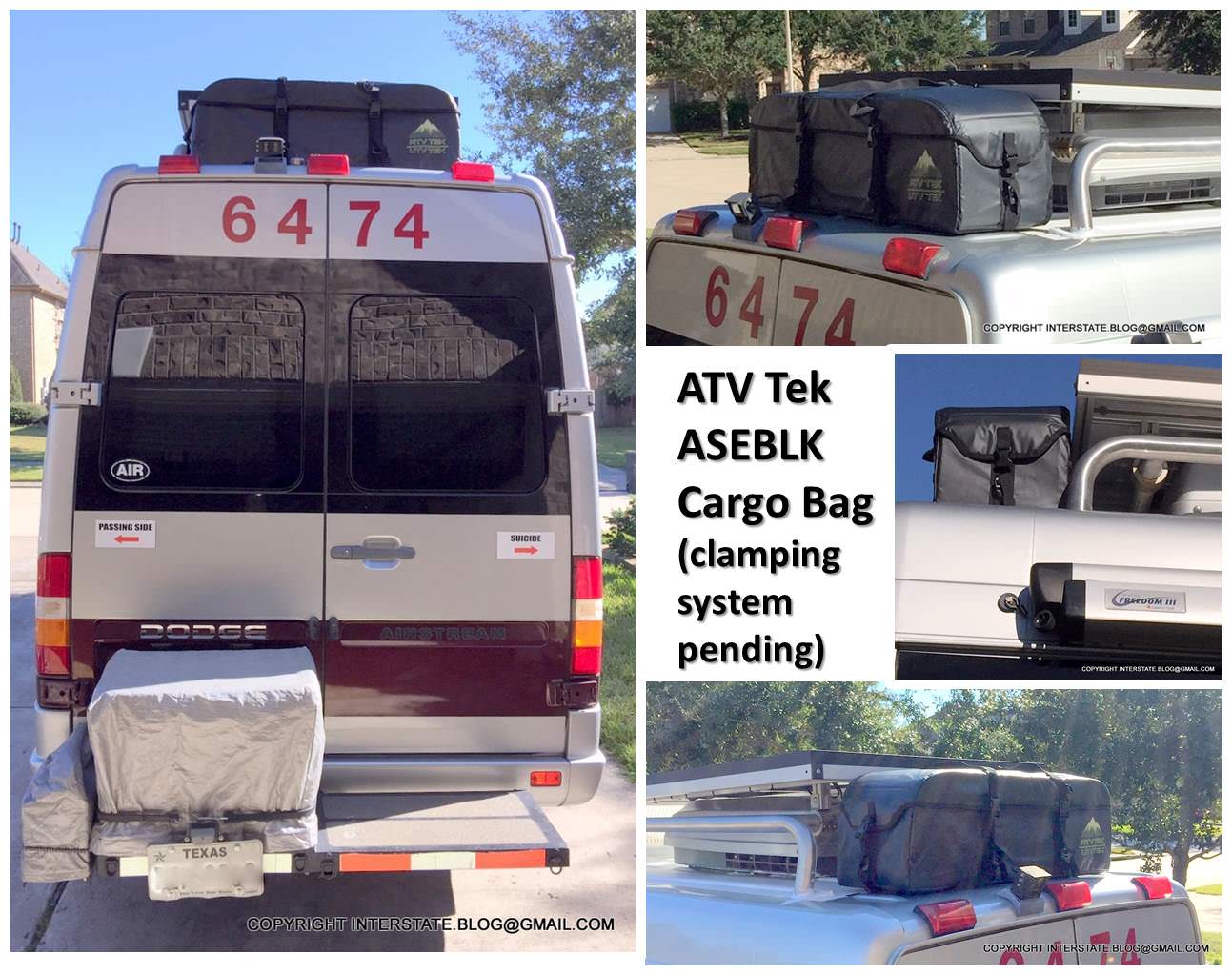
It just so happened that the ATV Tek ASEBLK Black Hunting and Fishing Expedition Cargo Bag fit the space like it was made for it.  
I used one of my favorite products as the underlayment on the roof, to allow for air circulation and drying, so that the ATV bag would not trap moisture next to the metal.
I cut a 1' x 3' strip of a Taskmaster rubber restaurant mat, which is the same product I cut down for our wet bath floor mat.  This product is officially known as the A1HC 35.43 in. x 35.43 in. Anti Fatigue Rubber Restaurant/Kitchen Mat.
Bonus with the Taskmaster: it could be pulled off the roof and used as a traction assist device if I ever got stuck.  I used a third of one of these mats to underlay the ATV bag, and I'll probably find another reason to put the other two thirds up on the roof eventually.

Here's what the ATV bag looks like positioned to fit:
It covers the raw open end of the solar panels on the rear end, giving it a more finished look.
I mentioned above that I didn't need to use the referenced clamps that I originally thought I would need.  Given the way the thing butts up against the 8020 solar panel frame, and given that existing hold-down straps were mounted on the bag in key areas adjacent to the frame, I decided to use screw eyes instead.  My husband sourced stainless steel eyes and also bolts that were compatible with the 8020.  With those in place, I simply attached the bag using 175 pound zip ties.  Here are a few pics.
Eye bolted into the underside of the 8020 solar frame, right next to one of the carrier clasps.

View underneath, showing the zip ties connecting the eyes to the existing bag straps.
Gratuitous pic of dog in the process of solar recharging.
Detail of how this attaches:  

(1) The bag is attached to the Taskmaster rubber underlayment mat using the straps that would typically attach it to the back frame of an ATV.  

(2) The rubber underlayment, in turn, is attached to the roof rack using 175-lb zip ties.  This commercial grade rubber mat is extremely strong and it would take tremendous force to rip through it (these mats are so tough that one of my professional clients uses them in a petrochemical plant application).  I don't anticipate any issues with it.

(3) The upper edge of the bag is attached to the solar 8020 frame.

Like this. 
Now, you may be wondering two things.  First, what the heck do I put way up there?

Answer:  Necessary junk that would otherwise consume valuable space inside the van. Nothing expensive that it would hurt to lose if a thief got his nosy self up there (which is unlikely).
Like these painting supplies for a renovation project we are working on.  I'm transporting the paint itself, 3 gallons worth, inside the Yeti that this is sitting on.  I don't want paint inside the van. 
Secondly, how the heck do I get up there to load and unload the bag?!  It's ten feet in the air!
Using my Telesteps 1400E, ladder of a thousand uses, which I have secured to the hitch platform.
I have a dedicated very-tight bungee so it won't slip.  And if I'm really struggling with anything in the bag, I can also bungee the top of the ladder to the roof rack itself for added stability.  
The hitch platform is covered in non-skid tread, plus the ladder is secure.  It's actually safer in this configuration than it is when I'm using it on open pavement.

Anyway, I'm delighted with this mod.  Glad I found an appropriate bag to create this most unlikely combination.