Showing posts with label SOLAR. Show all posts

Sunday, February 7, 2016

SOLAR PANELS ON THE ROOF, PART 3: PANELS IN PLACE

As I mentioned in Part 2 of this series, I'm not going to run through every technical detail of the solar panel installation because the general procedure has already been described by others.  I'm intentionally limiting the description to just those aspects that are unique to this installation on our 2007 T1N Airstream Interstate.  Photo coverage continues below.
Board for the charge controller, which my husband constructed.  There's also a fuse and a switch on here. 
This is the other side of that board, with the solar panels' On/Off switch visible.  The black object at photo bottom is our black water tank - this is the view upon opening one of the drop-down bottom cabinet doors.  On the other side of this new board is the existing electrical converter.  
Now for the reveal of how exactly we got those fixed-frame solar panels nine feet into the air without damaging them and/or killing ourselves.
The long ladder in the middle is an extension ladder covered with blankets and lashed to the roof rack at the top.  That was the "skidway" upon which the panels were raised.  The panels are shown on the ground to photo left, and you can see two ropes tied to their frame.  I stood on the roof with one rope in each hand.  My husband helped guide the panels up the skidway so that the assembly wouldn't topple over the side.  Gradually I cranked them up the skidway and then positioned them upright on the roof.  
See, I come by my skidway knowledge honestly, because I grew up around this sort of stuff.  This pic shows a conventional skidway upon which small fishing boats are raised.  Bay of Fundy, Nova Scotia.  
Unfortunately I have fewer photos of the raising process than I would prefer.  There was just my husband and me working on this, and so I was too busy with the job to take pics.  No free hands for most of it.
See where I've indicated the hinge here? There are two of them along this front crossbar.  The hinges were the key to success of two people getting this into place with no special equipment.  We were able to stand the panels up 90 degrees to the roof, and my husband fastened the hinges with it in that upright position.  With the front edge secured like that, we were able to then pivot it into place and proceed to the rear fasteners.

Oh, BTW, the 80/20 has nice end caps that set in place with stainless steel screws.  We hadn't installed them when this pic was taken, so you can see the open lattice at photo left.  
There's hubster tightening the down-rod that fits into one of the two rear clamps.  The un-tightened clamp is temporarily leaning toward photo left.  We screwed the rear pieces into place, but it was a complicated and time-consuming job to set those screws and their corresponding 80/20 track pieces.  We are probably going to replace those with a cotter pin type apparatus.  If we decide to stay somewhere remote for a few days, it would be useful to raise the panels to a more advantageous sun angle, pivoting it up on the front hinges.  We will have to make a supplemental support for the rear of it as well, in order to angle it up like that.   
You can see a slight pitch forward of the solar frame - the front (photo right) is lower.

We would have preferred to install the whole assembly an inch or two lower than shown here, such that the bottoms of the panels were even closer to the top of the A/C unit, but that would have required a whole 'nuther fastening system.  Unfortunately the OEM T1N Interstate roof rack had been set at the exact worst height - if it had been either higher or lower, this would have been an easier job.  
"I'm sore," he said a couple of hours following this monumental task.  It's little wonder.  Working on the roof of an Interstate requires a lot of contorting.  
There's the near-view as it was being lowered into place at the rear, and before we cleaned up the roof and trimmed our black plastic clamp gasket material. 
And there's a farther view, also prior to full completion, but I propped the extension ladder against the house and climbed up so I could look down on it.  
What's left of this task is to (a) verify that it actually works, and (b) confirm that there are no unexpected or intolerable vehicle handling ramifications.  In theory there should not be - Airstream specified a weight limit for their OEM roof rack (as useless as it is), and we are significantly under that limit.  Plus we angled the front of our panels down so that they would not catch wind at freeway speeds.  But this is brand new DIY territory here, so nothing is declared a success until it is fully tested and proven.
I actually sort of looked a bit like this when I was a kid...   

Monday, December 28, 2015

SOLAR PANEL INSTALLATION, PART 2: EXTERIOR COMPONENTS

In the first part of this post series, I talked about our rationale for DIYing a larger-capacity solar system in our 2007 Airstream Interstate T1N Mercedes Sprinter-based Class B RV.

In this post I will describe the principal external components and the general approach to this job.  I'm not going to include precise measurements or detailed instructions because (1) installation principles have already been described by others, especially the solar equipment vendors, and (2) we may be the only T1N Interstate owners on the planet who choose this particular solar array and installation strategy, and therefore it's not worth it for me to over-do the details.  There are easier ways to do this type of project, and there certainly are cheaper ways.  If any reader does decide they want more information on this exact installation, please contact me via interstate.blog -at- gmail and we will chat.

So here goes my attempt at giving a general orientation and a "feel" for the project.
As explained in the first post, our plan was to use the high-quality but functionally useless OEM roof rack that Airstream installed on the T1N Interstates.  Here you can see that both the air conditioner and the Fantastic are higher than the rails, so this requires a vaulting system for the panels.   
For the panels themselves, we chose a Grape Solar model called GS-S-100-TS.
Tap to expand for clarity. I'm adding this excerpt from the technical data sheet (PDF link) to distinguish this panel from other models, some of which appear similar but are lower efficiency and different construction (and less expensive).  
Here is what one of the 3 panels looks like when "dry fit" framelessly in the intended space:
By coincidence, these panels were exactly as wide as the rails, literally to within millimeters.  Photo taken by me standing on the roof.  You can see my husband to photo right, standing on the Telesteps 1400 E ladder that we keep in our Interstate.  
We bought 3 of these panels and other components to be described from a small company called AM Solar.
I think they were happy to receive our rather large order.  These photos are from the packing materials.  
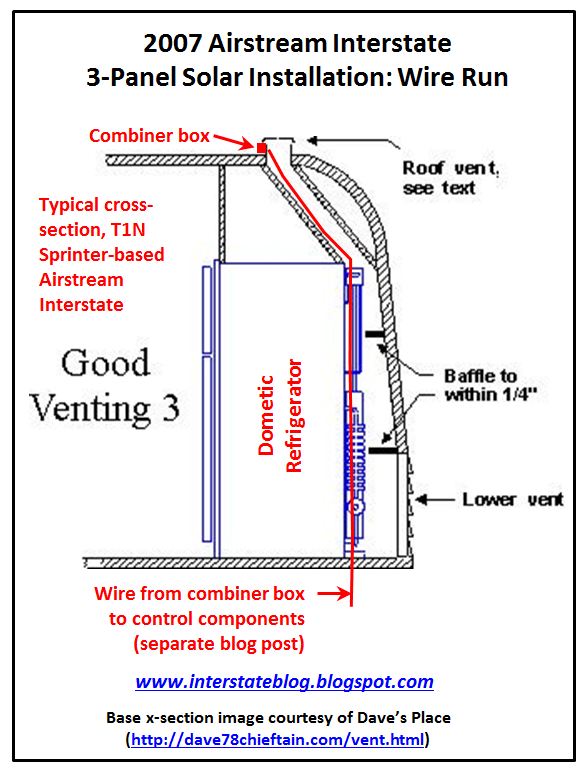
We decided to run the wiring for the panels down through the propane refrigerator vent.  AM Solar sells what is called a Refrigerator Vent C-Box (with the "C" standing for "combiner") for exactly this type of retrofit.
Tap to expand for clarity.  This is a simple diagram that will be reflected in the next few photos to follow.
Thanks to Dave's Place for the base image.
My husband bought this type of wiring from Lowes, but recommends to other DIYers that it would be better to get a similarly spec'd wire with a larger number of thinner strands.  The wire he bought was available locally but was stiff and challenging to work with.
Here is the installed combiner box with the cap off, shown penetrating the side of the fridge roof vent.  
Cap on. 
Screen replaced on vent, but rain shroud not yet in place.  Note that there is an elbow conduit visible just to the right of photo center.  That part did not come with the combiner box - my husband added it to protect the wire.  
Wire then comes down through the fridge cavity and proceeds below the cavity floor (we did this part of the installation while replacing our Dometic 2351 refrigerator which is described in this post).  The solar panel wire is zip-tied to the existing bundle to keep it from interfering with the fridge.  
Here's where things get more interesting and non-standard.  Because we were mounting these 3 panels on the OEM roof rack, we could not use conventional hardware such as what is shown in this photo which I screengrabbed from this Roadtreking blog entry.
Gosh this makes me nervous! Those tiny little adhesive feet and those tiny little panel clamps! It looks so flimsy to my untrained eye!  But I've never once read an account of a solar panel flying off a roof and landing on a highway, so my durability fears would seem to be unfounded.  
Of course, that particular Class B poster had no roof air conditioner to contend with, a scenario that would make any Houstonian faint dead away with shock.
Here's a closer view of a conventional attachment mechanism for direct on-roof placement, photo screengrabbed from this forum thread.  I believe that some folks use only adhesive - no screws. 
We decided to build a frame out of a versatile extruded aluminum product called 80/20, which tag-lines itself as "the industrial erector set".  The next series of pics shows how those components go together.
You've heard the adage "measure twice, cut once"?  Well, with this expensive 80/20, I suggest measuring fifteen times before placing your order.  My husband got the order exactly right on his first try, but it took him many hours of pondering and calculating before he pressed the "buy" button.

Here you see the general arrangement of the support rails.  The center gap is larger for maximum air conditioner clearance.  We wanted the panels to be vaulted above the a/c, but no more than necessary, in order to minimize the degree of wind that the panels would catch and the degree to which we would affect the vehicle's center of gravity.
We used our drill press to punch new holes in the Grape Solar panel frames for our non-standard attachment to the 80/20.  A hand-held drill would have posed a risk of punching through the glass panels themselves. 
The panels attach to the 80/20 rails using these stainless steel assemblages.  The "tongue" slides into the slots in the 80/20. 
This is a cross section, so that you can see what I mean by "slots".  
Every part of the 80/20 system goes together with its own special hardware. 
It takes a special tool to reach in there and tighten.  
Close-up of one part sliding into another. The end is threaded so that a protective cap can be screwed on. 
There's the finished assemblage, back side, with everything tightened up.  
Front side view.  
In my next post, I'll talk about how the clamps and risers are attached to the OEM roof rack.  That post may be a bit more time in coming, because we still have to weld receivers for the risers onto the cylindrical clamps that attach to the roof rack.

Sunday, December 27, 2015

SOLAR PANEL INSTALLATION, PART 1: PREAMBLE

Our 2007 Airstream Interstate Class B T1N Sprinter-based RV was born without a solar energy installation for recharging our house battery (newer models have multiple batteries but our original configuration only had one Lifeline).  After a year of ownership and about a dozen in-state overnight trips, with our forays being limited by our family responsibilities and employment schedules, we decided that we wanted to go ahead and DIY a solar system.  We knew it would be a big job that would take some time, but our long-range plan is for more elaborate off-grid trips, and we want to be ready when that time comes.
Because gosh knows that I have very little regard for staying in campgrounds.  Hookups are nice, but there's a terrible experiential price to be paid for those conveniences, as I explained near the end of this post.  And the generator is good to have for emergencies and short-term uses, but I don't want to be deafened by it when I should be enjoying the great peaceful outdoors.  
As far as we know, our plans in this regard were unprecedented.  Neither my husband nor I had seen an existing example of a T1N Interstate with a retrofitted solar system, either in the resale market or on Air Forums.  With the amount of work and expense associated with this job, we did extensive research on what would be the best way to accomplish our goals.  Here are a few sources from which we gleaned our concept-level information.
  1. Without question, Handy Bob's elaborate solar power diatribes are the best on the internet, especially this one which describes some common pitfalls associated with both DIY and professional RV installations.
  2. We were well-cautioned by the seemingly endless solar-related thread-hatching on Air Forums.  As of the date of this blog post, I can safely report that there is not another system on the Interstate that causes as much angst for owners as the battery maintenance, which in most model years hinges primarily on the efficacy of the vehicle's corresponding solar system.  You can read this thread and this thread and this thread and this thread and still not even remotely be done with the conversation as it relates to Airstream's solar installations, electricity management hardware, accidental coach battery ruination risks, parasitic system draws, the emerging potential for lithium battery upgrades, and other facets of this complex issue.  
  3. In our research, we also encountered some anecdotal reports that influenced our decision tree.  This Roadtreking post subtitled "Adding Solar to an Older Class B" was among the useful vehicle-specific sources we found.  
One theme that persisted across many different accounts was the need to over-design the solar system.  In theory, you calculate X amount of demand and so you install X amount of solar capacity and you're done.  In practice, you calculate X amount of demand and then proceed to install perhaps as much as 2X or 3X capacity in order to be responsive to systemic inefficiencies, unforeseen circumstances, unavoidable parasitic draws, and other logistical limitations.


Given my desire to use our Interstate as a mobile personal workstation, my future electricity demands could be higher than those of the average vacationer.  For that reason, one of the first big questions that we had to address was where to put multiple solar panels on the roof of our T1N Sprinter-based Interstate.  The available space is small and there were already multiple pieces of equipment installed up there, including a Dometic air conditioner, a Fantastic roof vent along with its cover, propane fridge vent, digital OTA TV antenna, cab radio antenna, back-up video camera, extra brake lights... all that on the roof of a 22-foot camper van.  And remember Handy Bob's number one solar lesson - nothing can cast a shadow on the panels because any interference whatsoever will cause the systemic efficiency to plummet.
One of Handy Bob's no-no's, screengrabbed and annotated from this post.  Tiny shadows can scuttle the efficiency of the entire system, but many owners and installers are either unaware of this, or in denial regarding it.
I took my solar installation inspiration from this startling T1N Interstate photo that appeared in the resale market in mid-2015.
Holy crap!!  How did those owners get those kayaks on and off that roof?!
The genius in that kayak mounting example was that the owner(s) installed a second roof rack on top of the existing OEM roof rack, thus making that section of the roof do double-duty in supporting both the air conditioning unit and the cargo vaulted above it.   And if they could successfully do this with big bulky kayaks, surely we could do it with solar panels.  Right?
The OEM Airstream-installed "roof rack" on the first generation of Interstates is an odd contraption.  It is simultaneously the highest quality and most useless appurtenance that Airstream elected to add to the T1N Sprinter.  It is made out of high-quality stainless steel tubing that shows incredibly tight tolerances - how does a diameter of 2.001 inches sound in terms of precision manufacturing?  Where did Airstream get this stuff??  And yet in its original form, it is good for pretty much nothing, because both the Fantastic and the Dometic air conditioner protrude into the space above it, preventing anything from being placed on it.  
Such an expensive piece of hardware ought to serve a purpose other than merely decorative, which may have been Airstream's intent given the corresponding physical limitations described in the photo caption above.  In my next series of posts, I'll talk about the strategies for maximizing the utility of this device, and the installation of our solar system components.