Showing posts with label TRIPS - OVERNIGHT. Show all posts

Monday, May 15, 2017

STEINHAGEN DAM B, REVISITED

Just a couple of pics of the US Army Corps of Engineers campground known as Sandy Creek Park, because I've posted about it before, almost two years ago.  The real treat in this blog post comes at the very end.
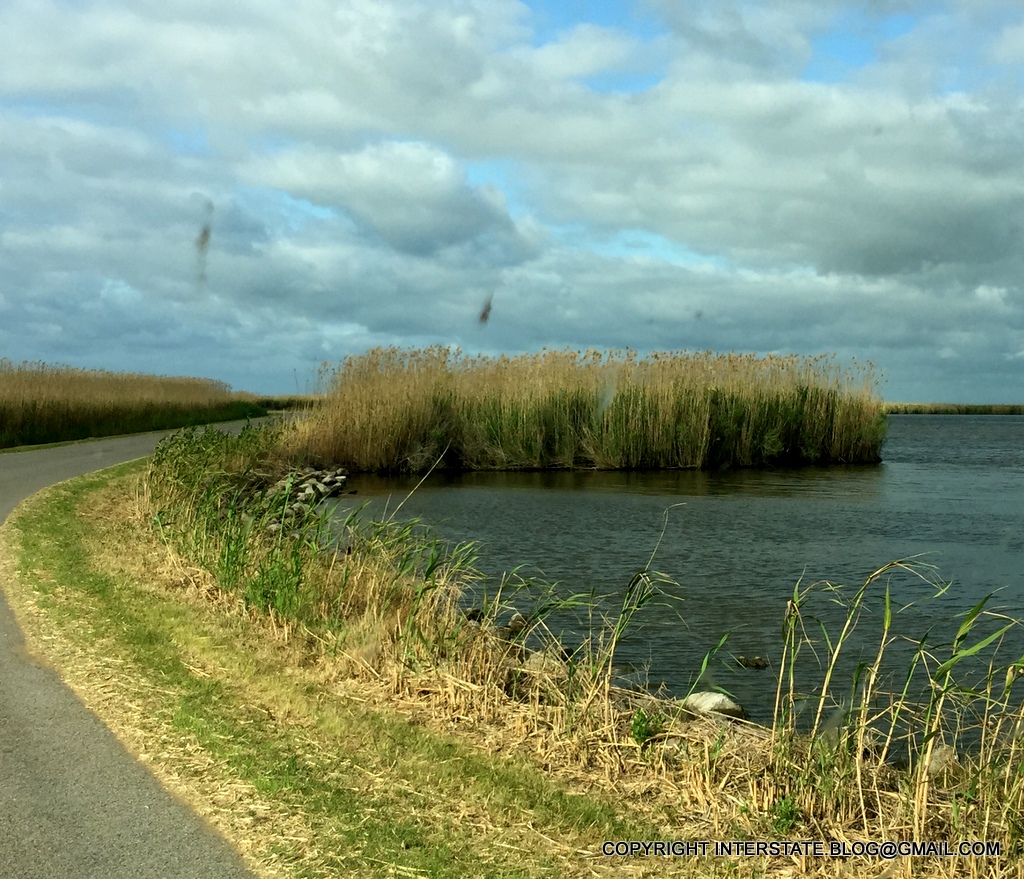
View from my back door, before sunset. 
There's the beginning of the sunset, and my Live Infinitely hammock.  
It was a show-stopper, I tell you, but not as much of a showstopper as this next bit.
Here's what you need to do for full authentic effect.  View this on a computer system (not a phone) with full stereo sound.  Turn up the volume until the bird song in the background is as loud as you would expect if you'd been there in person.  The alligator vocalizations at that point will be as loud as they were in real life.  Replay the video if necessary, because the first big vocalization happens at the two second mark.

You can also see the larger of the two gators for about half of the clip.  He's way out in the water to center left, about half way down, between the horizon and the shore.  You can see him moving but then my iPhone refocused on my rear door no-see-um screen, and the view of the critter was lost at that point.

This is why I like camping in a van, instead of in a tent on the ground.  I can sit up in bed and slam that rear door shut if I need to.  For a few moments this morning as I was figuring out what all this ruckus was that was transpiring around me, I thought I'd need to be slammin'.  That's a HUGE gator to be making that intensity of noise.  There are gator warning signs posted in this park.  This is why.


Monday, May 8, 2017

LONE STAR HIKING TRAIL AT DOUBLE LAKE, TEXAS

Local travel in May starts to become iffy around greater Houston, both because of the heat and because red bug (chigger) infestations are on the rise.  Red bugs make mosquitoes look like the plague of outdoor amateurs.  And northerners.  Whenever I see a #vanlife person eschew indoor van plumbing or showers, I immediately know that they are not from the south, and don't travel in the south in warmer weather and thus know little about parasite control (showering immediately after hiking is one of the best ways to control the mites).  One good red bug infestation would change their minds overnight, oh hell yes.

Despite this plague, we had a cold front come through and we took full advantage of it with about 43 hours in the Coldspring, Texas area, leaving Friday afternoon around 3 p.m., arriving in time to take advantage of the evening, and returning home Sunday morning around 9 a.m. before all hell broke loose traffic-wise on Houston's freeways.  Here are a few photos.
Here's the fun part of boondocking:  I picked our destination basically by closing my eyes and pointing my finger at a map.  That location ended up being a hunter camp in the Sam Houston National Forest
I picked our destination by closing my eyes and pointing my finger at a map.  That's pretty cool when you think about it.
It can't easily be done unless your rig is equipped to boondock.  More than two years of sporadic free time we've now devoted to working on ours for this purpose.  
Hunter camps are great resources but in our area it's important to remember that, during the off-season when no hunts are in progress, they tend to attract horse people.  And horse people run generators.  Such was the case with our first night, although we had enough separation that it really wasn't noisy enough to cause a major disturbance.

I did a 3-mile hike that first evening on a second hunting camp road that was chained off to vehicles.
The cold front had left some interesting blow-downs.  Vegetation looking like it had just been deposited five minutes previously.
Neither my husband nor I had ever seen this flower before, and we have about 70 years cumulatively in greater Houston.  
It looked like a variant on the black-eyed Susan, which are everywhere in our area.
And always photogenic.
Post-hike pondering of all those noises and smells out there. 
We had a wonderfully cool overnight, with temps falling into the 50s.
Our dog had to wear her "horse blanket" in these two crisp mornings.  It's actually an IKEA Toftbo bath mat, somewhat non-skid on the back, so friction holds it in place.  We shave our dog routinely, otherwise her entire body would be as long as her tail.  This is a necessity in subtropical Houston with its temps that reach over 100 degrees, but it's a bit of an inconvenience on cold spring mornings in Coldspring Texas.  
After our overnight at the hunter's camp, we moved on to the Big Creek Scenic Area.
Forest Service roads... I had great fun messing with our new Garmin 770 LMT GPS unit during this trip.  I absolutely, emphatically do not recommend running this device in RV mode, and this Air Forums thread explains exactly why with examples that I developed based on my testing.  But it seems to work coherently in car mode.  I will need it later this summer for my intended plan to drive across the continent solo, without the benefit of a human navigator. 

While off-leash, the dog is trained to remain behind the human, to minimize the chances of viper encounter.  In my blog post about Lake Houston Park, I showed a pic of a water moccasin that we encountered.  In this area, copperheads were a larger danger.  
The greater Houston area consists of flat coastal plain and piney woods remnants, for the most part.  Floral diversity tends to be limited and subtle in woods such as these.
Blue-green and yellow-green forest floor assemblages in one place... I've never seen this before. 
We chose Big Creek for this reason, because of the topography (rare for this area) and diversity.
This section of the Lone Star Hiking Trail was in excellent condition due to its exclusive use as a hiking trail.  As much as I want to see outdoor activities expanding in quintessentially car-crazy Houston, I often end up defaulting to the cliche' "Houston we have a problem" whenever I encounter a trail that has been destroyed by off-road cyclists.  
More flowers I don't usually see.
After the Big Creek hike, we moved on to Double Lake.  We got there before noon and the hosts advised us that there were a few hook-up campsites remaining.
You might be tempted to look at this and exclaim, "Whadda deal!" because hook-up sites appear to cost less than primitive sites. But that price means 'on top of'.  Generally I'm very pleased that the prices have risen this way ($37 total for our overnight, including day use fee).  Twelve years ago when I stayed here, the modern-day construct of workampers (camp hosts) had not yet been invented.  Those people need to be there to maintain order and to protect the facilities, and they need to get paid. 
We don't need hook-ups, but we decided to stay a second overnight and it was a convenient location, so we purchased one of the remaining hook-up locations.  Actually there were multiple open, non-reserved locations.  This park engages an internet reservation service, but like every other one I've seen in Texas, it's woefully inaccurate.  It shows far less availability than is actually present.  Campgrounds like this lose substantial revenue for lack of reservation technology investments.
During the hottest part of the day, I strung up one of my hammocks at our campsite and gazed at the sky.  My husband and I are both fairly driven people and it's rare to have a day of "down time" like this. 
My husband had never been to Double Lake.  It's a great car-camping location, so I had been there 12 years previously when my daughter was small and we were still doing multi-family group camping with her friends.
The doubleness for which Double Lake is well-known.  All lakes produce reflections, but this one amplifies the process due to its size and orientation relative to the sun.  
This wasn't even a very good day for the reflections.  Depending on weather conditions and canoeing intensity, they can get much more vivid than this. 
My husband taking stealth photos of the dog and I, except his phone camera lens is always dirty, giving that classic cell phone milky appearance.  
We hiked another 3 miles down the Lone Star Trail, but not before having a picnic.
And one of us had a nap.  Is that the face of pure bliss, or what?  But if you sit on the ground like this, there might be chiggers.  And yes there were, on this day. 
Two of the items without which one should never travel in a camper van are duct tape and gallon-sized zip lock bags.  Here's an example why.
My Osprey in-pack water bladder burst a leak at one of its sonic or thermal welds.  You can't see it because it's covered with duct tape, but IMO it was clearly the result of exceptionally poor product design (the REI site says "no longer available" and it gets plenty of one-star reviews - no surprise).  My husband responded to this event by ordering me a military-grade bladder as a replacement.  I'm sure glad this failure didn't occur later this year when I plan to be boondocking and long-distance hiking in Middle Of Nowhere, Canada.  
I was a bit bummed coming back from this trip, as it might be our last prior to my departure for Canada later this year (my husband will join me some time later by flying up and we'll drive back together).  Between our schedules and the impending hot weather, our seasonal camping door is closing here in greater Houston.
I don't know if there's any scientific validity to claims about "forest bathing", but a WSJ (I think that was the source) article appeared on the same day as this trip, so here's an excerpt.  I'd link it but now that I'm on my desktop instead of my phone, I can't seem to find it.

Tuesday, April 25, 2017

SEA RIM STATE PARK AND FOUR NATIONAL WILDLIFE REFUGES

Yet another of my whirlwind tours, this time of the upper Texas coast rather than south Texas, and here are some pics and anecdotal comments.

(1) TRINITY RIVER NATIONAL WILDLIFE REFUGE

With 30 million people in Texas but only 1.8% of Texas land being federally-owned (PDF link), you can bet that, at times, things get a little strange around here.  Every federal installation has serious access pressures and some discretion to enforce its own rules, balancing the wildlife preservation mandate against public interest and pent-up demands of too many people who have too few public spaces available to them.  For that reason, policies are variable and access is unpredictable at best, if it exists at all.
The weirdness starts with Googlemaps, which doesn't even name or label portions of this particular refuge (shown anonymously in green above).  The NWR's web pages are no help, because they simply direct the public to "contact the refuge".  But then of course if you try to "contact the refuge", you'll be hard-pressed to locate anyone.  And then if by some miracle you do locate someone, the answer is often "no".  
We drove up to Trinity NWR to see what we could find, and the answer was a big fat nothing.  That trace on the Googlemap called Camp Road wasn't even a public right of way.  There were signs warning of imminent death if one chose to trespass on private property.  Which had every appearance of being federal land, but let me not go off on that tangent.

So, we decided to leave that one for future sleuthing, and we moved onward to our local coastal jewel, the sure-thing known as...

(2) ANAHUAC NATIONAL WILDLIFE REFUGE.

I blogged about this place last year, and it is a gem.
Shoveler Pond. 
A portion of Shoveler Pond at sunset.  I see lots of mountain majesty on Instagram, but we don't have those kinds of massive natural features on the Gulf Coast.  We have to look for the beauty in little things, like sunset colors. 
I say "we" because this short journey started on a Sunday, and my husband and dog followed behind me.  He had to go to work Monday morning and so did I, but my assignment was in Beaumont Texas rather than near our home base in Houston.  Sometimes we do this.  We travel locally and take two vehicles, and then he leaves when it's time to sleep.  It's imperfect but it's the life of working people.  At least this way, I get to spend time both outdoors and with my loved ones. 
Lily pads in Anahuac.  Lotus, I think.  No mud, no lotus
Anahuac after dark.  Part of my purpose for this jaunt was to test my new rear door bug screen.  More on that in a separate blog post, but what better test for a rear door screen than a huge coastal marsh after dark?  Can you say mosquitoes?
Duckweed in said huge coastal marsh.  I forgot my DSLR so these are all iPhone photos.
Near the marsh overlook (boardwalk).
The boardwalk is all done up with stainless steel screws.  My husband speculates that they cost more than the lumber.  The significance of this will be shown by a contrasting photo below. 
(3) SEA RIM STATE PARK.

It was probably wonderful at one time, before it got obliterated by two major hurricanes (pretty much a direct hit by Rita on September 24, 2005 and then again in 2008 by Ike, the third most costly storm in U.S. history). But right now, it's a hot mess.  The visitor's center is a trailer that doesn't even have access to a septic (the park staff's wastewater drains into a honey pot), and there are no showers.  I don't think I've been in another state park that has no showers.
This is what happens when stainless steel screws are NOT used.  Most of the boards on Sea Rim's boardwalk have broken free and were sliding loosely between their side rails.  It's a beautiful boardwalk but the amount of deferred maintenance was staggering. 
I could tell right away that we were shaping up for a great sunset, though. 
And that would be it, as seen from the beach-side of this state park, rather than the marsh-side.  I have never seen a better Gulf of Mexico sunset. 
I had a paid reservation in the park's small campground - this state park does not allow any form of overflow (some do, some don't - again, it's all about access pressures).  However, once two Labrador retrievers began a bark-a-thon, I high-tailed it outa there, abandoning my paid spot and instead I went to park right on the beach, which was unusually wide and firm at this location, so it made for safe Airstream Interstate parking, all eight thousand pounds of her (that sentence is as long as the section of beach that I had all to myself).
Camper van on fire, at least figuratively.  
Every trip and every destination has pluses and minuses.  This was the plus for this one - I had a good square mile all to myself.
And the sunrise was even better than the sunset.  Here's the first peek above the horizon...
...and here's the Full Monty.
When I woke up, the beach was covered with freshly dead fish that had not been there the evening before.
They all appeared to be the same size and species. 
As soon as the seabirds discovered this windfall, there was a great pandemonium of activity as they gorged themselves.  But I could not get any decent phone pictures.  Birds in far-flung areas are not as tolerant of humans as those in urban areas.  They fly away before you even get remotely close.

Speaking of far-flung areas...
I finally got to test part of my new connectivity improvements.  And I was very pleased!  Those are actual "before" and "after" screengrabs of my iPhone's homepage.  Before I flipped the switch, and after I flipped the switch.  Thanks to Technomadia for that one!
(4) McFADDIN NATIONAL WILDLIFE REFUGE
(5) TEXAS POINT NATIONAL WILDLIFE REFUGE.

I did manage to speak to a human at their joint headquarters, and he was quite nice in explaining the management principles that apply to both refuges, and the reasons behind those decisions.  Which gave me some ideas for state and federal policy suggestions.  Which I will discuss in another blog post in the future.
Much of McFaddin looks pretty much like this.  These refuges are largely set-asides for migrating birds.  
Another shot of McFaddin, with bugs squashed on my windshield for special effect.  
Neither refuge had any real pedestrian access.  They are mostly geared toward hunters and fishermen.
Texas Point had a short woodland trail.  Plenty of these were blooming.  They appear as if they might be a coastal rose species (based on what I know of wild roses that grow in Nova Scotia), although they did not smell like roses.  
My main aspiration when I go to an unpopulated area is that I might find some biking or hiking access.  I want to get out and move around over long distances and get serious exercise without motorized vehicles, and that's a very, very tall order in Texas, which is more than 95% private property (PDF link).
To that end, I went to where Texas-87 was blocked off.  It used to be a well-appreciated coastal highway joining High Island and Sabine Pass, but it was abandoned after yet another historical hurricane damaged it beyond repair for much of its coastal length.
I know what the western terminus of Texas-87 looks like - it's under water as a series of dissociated asphalt chunks, literally.  I was hoping that this eastern remnant might hold some promise for biking.  Alas, it doesn't look good, does it?  Hiking, maybe.  But Nature has pretty much taken it back by this time.

Driving back to Houston from this area is trippy in its own way.
In order to get in and out of Sabine Pass, you have to literally drive through a couple of Port Arthur refineries. 
Anyway, another successful road test of our lithium battery system and now our connectivity improvements also.  And some ideas for future endeavors came out of this trip, which I will discuss later.

Wednesday, April 19, 2017

MUSTANG ISLAND STATE PARK

Being a self-employed working person, I'm used to frantic schedules and hyper-travel, but what I just did was a bit extreme even for me.  I mobilized from Houston to Corpus Christi for a business meeting and, not knowing how long the resulting work might last, I booked a few nights in Mustang Island State Park.  But then the schedule changed, and I ended up returning to Houston within 28 hours of my initial departure.  My head spins, but I did manage to squeeze in a good walk on the beach on the evening of my arrival.  Here are a few pics.
Unlike my recent night on the beach at Bolivar Flats, I would not take our Airstream Interstate onto this beach.  Too much loose and uncompacted sand and too many soft spots.  Most passenger cars could probably do it safely, but not an eight thousand pound van.  The adjacent Padre Island is something of a rite of passage for beach boondocking, but if that, too, looks like this, I'll be crossing it off my list of possibilities. 
The beach is subtly distinct from those a few hundred miles up the coast.  This is not just a "grass is greener" perception.  The water really is bluer.
To make a long story short, it has to do with sediment.  The Corpus Christi area is visible southwest of Houston, by about 1.5 widths of the word "Houston" in this NASA photograph which shows river plumes.   
That plus the lower intensities of urbanization and industrialization combine to preserve a more pristine environment (about 0.5 million people in the Corpus Christi metro area vs. 6.5 million in greater Houston).
The air is cleaner.  The sky is bluer.  The water is clearer.  The sand dunes are much higher.  The birds are more dispersed because there is a larger selection of places for them to nest, vs. a more intensely-developed metropolis with a limited number of natural areas remaining.  
We don't see signs like this around Houston very much either. 
See what I mean about the sand dunes?  Ours are meager in comparison. 
Prettiest shell I saw on my 2-hour walk. 
Their shadows and their reflections are at 90 degrees to each other. 
I saw lots of this activity, but caught no diggers in the act.
I had a reserved campground spot with hook-ups which of course I don't need, and so I spent as much time as possible in the parking lot with my back doors facing the beach.  The place was empty after the day-trippers left at dusk. 
The parking lot just before dawn.
After spending almost 30 years in this area but never seeing the sun rise over the Gulf of Mexico, I've now seen it twice in the span of a month.
With unsettled weather in the area, this one was more subtle than the burning ball I'd seen rising over Bolivar Flats last month.
Gulf of Mexico pastel palette. 
The forecasts say that we're getting a cold front this weekend - in late April!  I might have to capitalize on that and go back out again, one last time for the local season.
Not necessarily gigawatts, but upon discovering no electricity in the run-down women's restroom at Mustang Island State Park, I was able to blow-dry my hair by running my dryer off our lithium battery system for the first time on this trip.  I was headed from the beach directly to a business meeting, after all.  Gotta look professional.  Those are the little things that can make or break the use of a van to enhance work-life balance.